XW Machinery
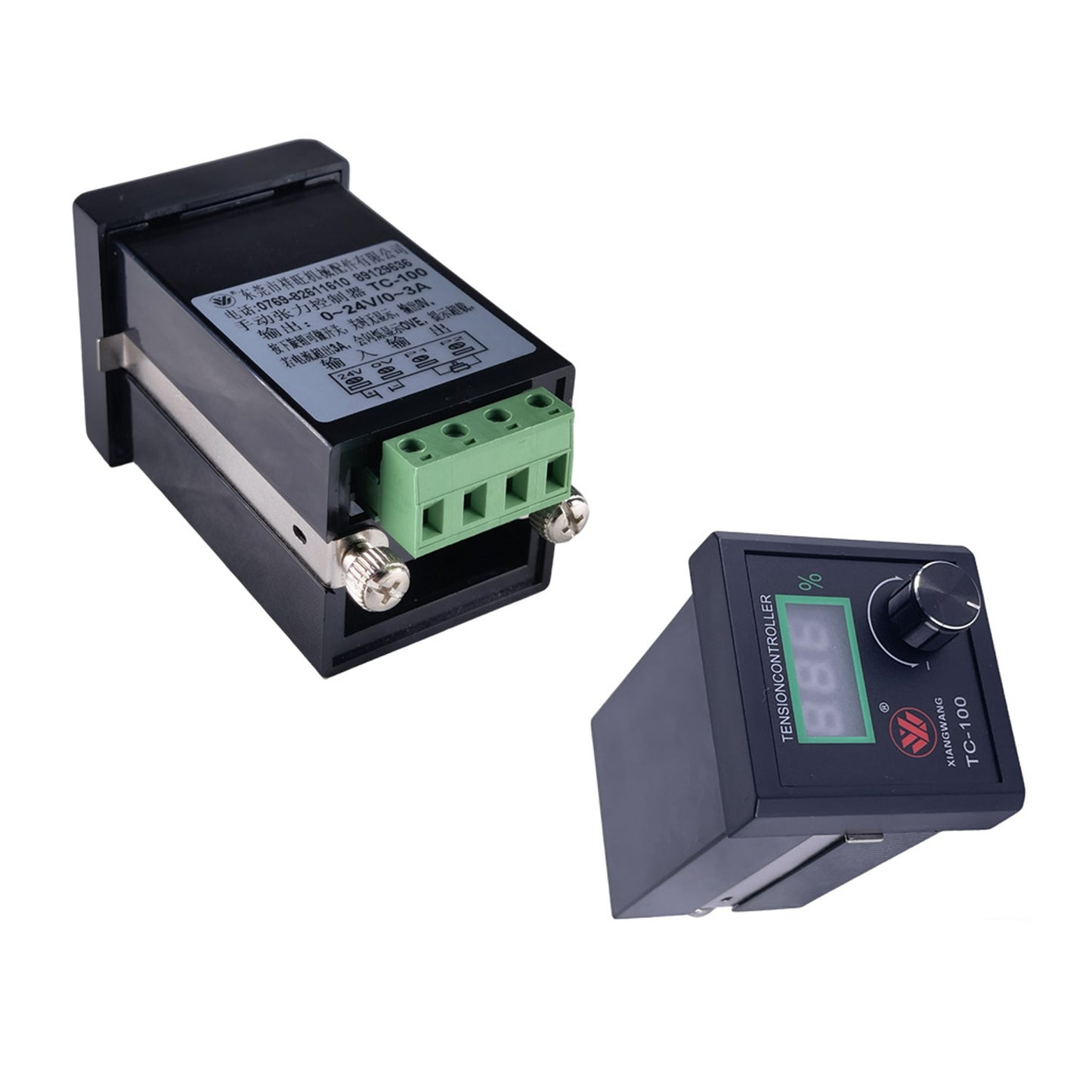
High-Precision TC-200 Micro Tension Controller - Upgraded Version
High-Precision TC-200 Micro Tension Controller - Upgraded Version
We will reply to you within 4 hours after receiving your inquiry.
Couldn't load pickup availability
The XW Machinery TC-200 Micro Tension Controller is a compact manual tension controller that regulates the excitation current fed to a magnetic powder clutch or magnetic powder brake, holding web tension steady during winding, unwinding, slitting, printing and laminating. It is the right choice when a machine needs repeatable, adjustable tension on light- to medium-duty webs but does not justify the cost of a full closed-loop automatic controller.
What Is the TC-200 Micro Tension Controller?
A micro tension controller is a small-footprint electronic control unit that sets and stabilises the torque produced by a magnetic powder clutch or brake. Instead of switching torque on and off, it varies the excitation current, which changes the strength of the magnetic powder chains inside the clutch or brake and therefore changes the transmitted torque. Because web tension is directly proportional to torque, adjusting the current adjusts the tension.
The TC-200 is the upgraded version of the XW micro controller line. The upgraded internal circuitry delivers a smoother, less drift-prone current output than standard economy modules, which shows up in practice as fewer wrinkles, less telescoping and less breakage on thin films, foils, labels and papers.
The controller is supplied in two model options, TC-200 and TC-100, so it can be matched to single-station or space-restricted machine layouts without redesigning the control cabinet.
How the TC-200 Controls Tension
- The operator sets the required output level on the controller front panel.
- The controller delivers a regulated current to the excitation coil of the paired clutch or brake.
- The magnetic powder inside the unit forms chains; higher current means stronger chains and higher transmitted torque.
- Applied to a roll of radius R, torque T produces web tension F according to T = F × R, so the tension follows the set current.
Because this is an open-loop arrangement, the controller holds the current constant rather than the tension constant. When the roll diameter changes, the tension changes unless the operator trims the setting. Where the process cannot tolerate that drift, pair the machine with a tension sensor and an automatic closed-loop controller instead.
Key Features
- Upgraded regulation circuitry for a more stable, less temperature-sensitive current output than standard economy controllers.
- Micro-size housing that fits compact machines and crowded control cabinets without a panel redesign.
- Direct drive for magnetic powder clutches and brakes — no intermediate power amplifier required on micro and small frames.
- Clear parameter display and intuitive controls, so engineers can calibrate tension during commissioning without a programming tool.
- Smooth output under acceleration and deceleration, reducing tension spikes at start-up and splice.
- Two model options (TC-200 / TC-100) for single- or dual-layout machines.
- Industrial-grade components selected for continuous duty in production environments.
Technical Specifications
| Parameter | Specification | Notes for buyers |
|---|---|---|
| Product type | Micro tension controller (manual / constant-current) | Open-loop control; no feedback sensor in the base configuration |
| Available models | TC-200, TC-100 | Both listed as variant options on this page |
| Controlled actuator | Magnetic powder clutch or magnetic powder brake | Matched to the excitation voltage of the paired unit |
| Excitation voltage class | Matched to the paired clutch or brake; 12 V DC and 24 V DC units exist in the XW micro range | Send us your clutch/brake model and we confirm the match before shipment |
| Output type | Adjustable regulated current to the excitation coil | Set within the rated current of the paired clutch or brake |
| Control mode | Manual setting, constant-current output | Add a tension sensor and an automatic controller for closed-loop control |
| Mounting | Compact panel-mount housing | See the installation drawing on this page for cut-out dimensions |
| Typical industries | Slitting, rewinding, printing, packaging, label, textile, film, lithium battery, wire and cable | Confirm material and tension range before ordering |
| Supply | Factory direct, OEM and wholesale supported | ISO-certified manufacturing, 13+ years of export experience |
Important: final electrical ratings are printed on the unit nameplate and repeated on the order specification sheet. Send us the model of the clutch or brake you intend to drive and our engineers will confirm the controller match, output range and wiring diagram before the order is released.
Typical Applications
The TC-200 is used wherever a light- to medium-duty web must be wound or unwound at a controlled tension:
- Slitting and rewinding machines
- Label and narrow-web printing presses
- Flexible packaging and laminating lines
- Paper and film converting equipment
- Textile and nonwoven handling
- Lithium battery electrode and separator winding
- Wire, cable and foil winding systems
- Laboratory and pilot coating lines
Materials commonly run under a TC-200 include plastic film, adhesive tape and labels, paper and board, thin aluminium foil, nonwoven, textile webs, and coated or laminated flexible packaging stock.
Wiring and Installation
Install the controller with the machine power isolated and locked out. A typical installation sequence is:
- Confirm the match. Verify the excitation voltage and rated current of the magnetic powder clutch or brake before wiring; the controller must not exceed the coil rating.
- Mount the unit. Fit the controller in a control cabinet position with clearance for natural heat dissipation, away from heat sources and oil mist.
- Route power and output separately. Keep the excitation output leads away from motor drives, inverter cables and contactor wiring to avoid induced noise.
- Use screened cable for the output. Connect the screen to earth at the controller end only, and connect the clutch or brake coil with the correct polarity.
- Earth the system. A single, solid protective earth point reduces drift and protects the electronics.
- Commission at low tension. Start with the output at minimum, run the machine at low speed, and raise the setting until the web runs flat without stretching.
- Re-check after warm-up. Magnetic powder units change slightly as they reach operating temperature; trim the setting after 20-30 minutes of running.
Installation notes that prevent most field problems: never plug or unplug connectors with power applied; do not run the output leads in the same conduit as servo or inverter cables; leave ventilation clearance above and below the housing; and record the final setting on the machine nameplate so operators can restore it after maintenance.
Matching the TC-200 with a Magnetic Powder Clutch or Brake
Selecting the actuator matters more than selecting the controller. Size the clutch or brake from the required tension and the maximum roll radius:
T (N·m) = F (N) × D (m) / 2
For a 50 N web tension at a 0.6 m full roll diameter, the required torque is 50 × 0.6 / 2 = 15 N·m. Do not size to this number alone: add a 20-30% margin for acceleration, friction and powder ageing, and check the slip power, since a clutch or brake running in continuous slip converts that power into heat.
Slip power is P (W) = T (N·m) × 2π × slip speed (rev/s). In the example above, 15 N·m at a 200 rpm slip is about 314 W — well beyond the natural cooling capacity of a micro unit, so this application should use a larger naturally cooled or forced-cooled frame from the 6-400 N·m range rather than a 1-5 N·m micro clutch.
| Application condition | Recommended pairing |
|---|---|
| Light web, low tension, compact machine (labels, small rewinders) | TC-200 with a 12 V micro magnetic powder clutch or 24 V micro magnetic powder brake |
| Medium tension, wide web, long runs (film, paper, packaging) | TC-200 with a 6-400 N·m magnetic powder clutch or DIN standard magnetic powder brake |
| Tension must stay constant as roll diameter changes | Use a closed-loop system: tension sensor plus an automatic web tension controller |
| Dual-station winding with roll change | Automatic controller with dual-station roll change |
| Cabinet space limited, control panel remote | Split type tension controller |
Frequently Asked Questions
What does a micro tension controller do?
A micro tension controller regulates the excitation current supplied to a magnetic powder clutch or magnetic powder brake, which sets the torque applied to the roll and therefore sets the web tension during winding and unwinding. It is a compact, panel-mounted alternative to a full-size automatic controller.
Can the TC-200 drive both a magnetic powder clutch and a magnetic powder brake?
Yes. The TC-200 drives either device, provided the controller output is matched to the coil voltage and rated current of the unit being driven. Clutches are typically used on the unwinding or driving side and brakes on the unwinding or tensioning side, but the electrical interface is the same.
What voltage does the TC-200 use?
The controller is matched to the excitation voltage of the clutch or brake it drives, and both 12 V DC and 24 V DC units exist in the XW micro range. Because the correct value depends on the paired actuator, confirm the model with our engineers before ordering; the confirmed rating is printed on the unit nameplate and on the order specification sheet.
Do I need a tension sensor with the TC-200?
Not for basic operation. The TC-200 is an open-loop controller: it holds the output current constant, not the tension. If the process tolerates a small tension change as the roll diameter changes, no sensor is needed. If tension must stay constant, add a tension sensor or load cell and move to a closed-loop automatic controller.
Why does the tension change as the roll builds up?
With constant torque, tension falls as the roll diameter grows, because F = T / R. This is normal behaviour for an open-loop controller and is corrected by trimming the setting during the run, by using taper tension control, or by moving to a closed-loop automatic controller that measures tension and corrects it continuously.
How do I size the clutch or brake for the controller?
Calculate torque from the maximum tension and the maximum roll radius using T = F × D / 2, add a 20-30% margin, then verify that the continuous slip power stays inside the thermal rating of the selected frame. Under-sizing the actuator is the most common cause of unstable tension and short powder life.
Does XW Machinery provide wiring support and OEM options?
Yes. XW Machinery supplies factory-direct units with OEM and wholesale options, and our engineering team provides wiring confirmation, model matching and parameter selection support, with a professional reply within 24 hours.
Related XW Machinery Products
- Miniature tension controller for magnetic powder clutch & brake
- Automatic web tension controller (closed loop)
- 12 V micro magnetic powder clutch (1-5 N·m)
- 24 V micro magnetic powder brake (1-5 N·m)
- Magnetic powder clutch, 6-400 N·m
- Magnetic powder brake, DIN standard
- Through-shaft web tension sensor
- Cantilever tension load cell
Further Reading
- How to choose a tension controller
- How to choose a magnetic powder clutch (2026 guide)
- Web handling troubleshooting and maintenance guide
Why Buy From XW Machinery
XW Machinery is a China-based manufacturer of web tension control components, with 13+ years of manufacturing experience, a 40,000 m² facility and more than 10,000 mechanical and electronic parts shipped annually. Every controller is function-tested before shipment, and we support OEM customization, private labelling and project-level selection work for machine builders, integrators, distributors and importers.
Need parameters, a wiring diagram or a quotation? Contact our engineering team with your machine type, web material, tension range and roll diameters — we reply within 24 hours.
Related Categories
Need this part built to your machine?
Send the specification — torque range, shaft size, web width and line speed — and we will confirm the model and quote.
Request a Quote WhatsAppShare