XW Machinery
XW® Custom 74mm Manual Air Shaft for Slitting & Rewinding
XW® Custom 74mm Manual Air Shaft for Slitting & Rewinding
We will reply to you within 4 hours after receiving your inquiry.
Couldn't load pickup availability
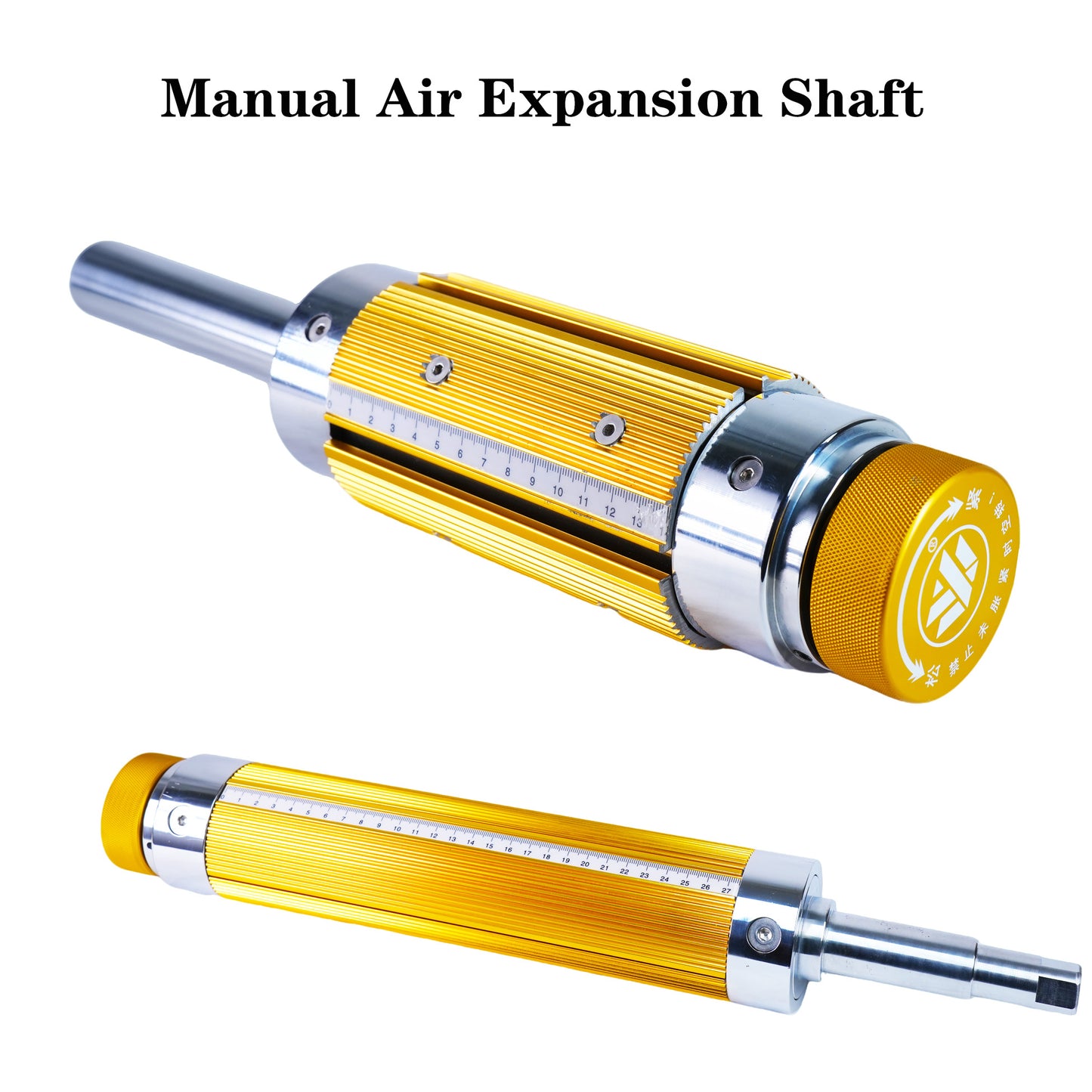
The XW® 74 mm manual air shaft is a 3-inch pneumatic expanding shaft that grips paper, film and foil cores by key-bar expansion, and is inflated by hand through a valve or pump instead of a rotary air union. It is used on slitting, rewinding and unwinding machines that need fast, slip-free roll changes without a permanent compressed-air line running into the shaft.
What Is a 74 mm Manual Air Shaft?
A manual air shaft is a key-type air expanding shaft with a body diameter of 74 mm before inflation, which is the standard size for a 3-inch (76 mm nominal) core. Compressed air pushes the key bars outwards, the bars clamp the inside of the core, and the shaft transmits torque to the roll through that grip. When the air is released, the bars retract and the roll slides off.
The "manual" part refers to how air is introduced: instead of an automatic rotary union on the machine, the operator inflates the shaft through a valve or with a hand pump, then deflates it for roll change. This makes it a practical choice for machines where air plumbing to the shaft is impractical, for retrofit projects, and for spare or secondary unwind stands.
XW Machinery builds this shaft to order: body diameter, overall length, journal ends, material and key-bar layout are all confirmed against a drawing before production starts.
How Does a Manual Air Shaft Work?
- The roll core is slid onto the deflated shaft, which is 74 mm in diameter.
- Air is introduced through the shaft valve, inflating the internal air bladder.
- The bladder pushes the key bars outwards, expanding the working diameter to roughly 79-82 mm and clamping the core evenly around its circumference.
- Torque is transmitted through friction between the key bars and the core, so the roll turns with the shaft without slipping.
- Releasing the valve deflates the bladder, the key bars retract, and the finished roll is removed.
Key Features
- Key bar / lug type expansion for uniform expansion and strong, evenly distributed torque transmission.
- 74 mm body diameter (3-inch standard) with custom overall lengths to match your machine.
- Manual inflation with quick deflation for fast roll changes and no rotary union requirement.
- High-strength steel or aluminium body, dynamically balanced before shipment.
- Works with paper, film, foil, tape, label stock and nonwoven cores.
- Replaceable bladder and key bars, so the shaft can be serviced instead of scrapped.
- Custom journal ends machined to your bearing blocks, safety chucks or existing machine interface.
Technical Specifications
| Specification | Options | Notes for buyers |
|---|---|---|
| Body diameter (deflated) | 74 mm | Standard size for 3-inch cores |
| Expansion range | 74 → 79-82 mm | Working diameter after inflation; set per core tolerance |
| Core size | 3 inch (76 mm nominal) | Adapters available for other core sizes |
| Type | Manual key type | Inflated by valve or hand pump, no rotary union |
| Body material | Steel / aluminium | Aluminium reduces weight on manual handling; steel for heavier loads |
| Shaft length | Customized | Confirmed on the order drawing |
| Journal ends | Customized | Machined to your bearing housings or safety chucks |
| Maximum speed | 500-1000 RPM | Depends on length, load and balance grade |
| Balancing | Dynamic balancing before shipment | Reduces vibration and noise on high-speed lines |
| Inflation | Manual valve or hand pump, workshop compressed air | Working pressure is marked on the shaft drawing |
| Application | Slitting, rewinding, unwinding | Suitable for standard printing and packaging machinery |
| Lead time | 7-15 days for standard builds | Custom engineering adds drawing confirmation time |
| Minimum order | 1 piece | Single replacement shafts are supported |

Every shaft is built from seamless steel tube or thickened aluminium profile under an ISO 9001 production system, and is checked for air tightness, dimensional accuracy and running stability before it leaves the factory.
Typical Applications
This 74 mm manual shaft is used wherever 3-inch cores are wound or unwound:
- Slitting and rewinding machines
- Printing presses and label presses
- Flexible packaging and laminating lines
- Paper and board converting
- Film and foil processing
- Coating machines
- Textile and nonwoven handling
- Tape and adhesive converting
Materials commonly run on it include paper, plastic film, aluminium foil, label stock, adhesive tape, laminated packaging webs and nonwoven fabrics.
Installation and Operation
- Confirm the interface first. Check the journal diameter and length against your bearing blocks or safety chucks, and check the deflated shaft diameter against the core bore.
- Support both ends. Mount the shaft in the machine with both journals properly seated; an unsupported shaft will deflect and cause run-out.
- Check for free rotation. With the shaft deflated, rotate it by hand to confirm there is no binding and no obvious eccentricity.
- Inflate gradually. Bring the shaft up to its working pressure and confirm that all key bars rise evenly before loading a full roll.
- Load the core. Slide the core on, inflate, and check that the roll is held firmly by attempting to rotate it by hand.
- Never run inflated without a core. Inflating an empty shaft over-extends the bladder and shortens its life.
- Deflate before unloading. Always release air completely before sliding the roll off to avoid scoring the key bars and the core bore.
Because inflation is manual, operators should deflate the shaft whenever the machine is stopped for more than a few minutes, and should never exceed the pressure marked on the drawing.
Maintenance and Troubleshooting
| Symptom | Likely cause | Action |
|---|---|---|
| Shaft will not hold pressure | Worn or punctured bladder, loose valve core | Soap-test the valve and joints, replace the bladder |
| Key bars rise unevenly | Bladder folded, core bore oversize | Re-seat or replace the bladder; check core tolerance |
| Roll slips during rewinding | Insufficient pressure, worn key bars, oversize core | Raise pressure to specification, replace the key bars, check core ID |
| Shaft will not deflate | Blocked valve, trapped air | Clear the valve, press the key bars in evenly by hand |
| Vibration at speed | Lost balance, bent body, worn bearings | Re-check balance, inspect the body for run-out, replace bearings |
Routine care is simple: keep the valve capped when not in use, avoid oil-contaminated air, store spare shafts deflated and horizontal, and inspect the bladder annually on shafts in continuous service. See our detailed guide on how to maintain an air expanding shaft for the full checklist.
How to Specify and Order
Most ordering problems come from missing dimensions rather than from the shaft itself. Before requesting a quote, have the following ready:
- Core inner diameter (3 inch for this model) and core material
- Shaft length — overall length or the distance between bearing centres
- Journal dimensions — diameter, length and any keyway or flat
- Load and speed — maximum roll weight and line speed
- Body material — steel or aluminium, and any surface treatment
- Machine type and, if possible, a photo of the existing shaft
Ordering process:
- Inquiry: send diameter, length and material requirements.
- Drawing confirmation: our engineers provide or confirm technical drawings within 4 hours.
- Quotation: factory-direct pricing based on the confirmed specification.
- Production: 7-15 day lead time for standard builds.
- Quality check: ISO 9001 inspection, including air tightness testing, before shipping.
Long shafts are packed in reinforced wooden cases to prevent bending in transit.
Manual Air Shaft Compared with Other Shaft Types
| Shaft type | Best for | Trade-off |
|---|---|---|
| Manual key type (this product) | Machines without air plumbing to the shaft, retrofits, spare unwind stands | Operator must inflate and deflate by hand |
| Lug type automatic | Heavy rolls, high torque, frequent roll changes | Requires a rotary union and continuous air supply |
| Leaf / strip type | Wide webs, gentle and uniform core support | Lower point-loading capacity than lug type |
| Differential (slip) shaft | Multi-roll slitting where slit widths differ in thickness or tension | Higher cost, more maintenance parts |
If your slit rolls telescope or vary in tightness across the shaft, the limitation is usually tension equalisation rather than core grip — in that case a differential air shaft is the right upgrade. See air shaft vs differential shaft for the full comparison.
Frequently Asked Questions
Is 74 mm the same as a 3-inch air shaft?
Yes, in practice. A 3-inch core has a nominal 76 mm bore; the shaft body is built at 74 mm so it slides in freely when deflated, then expands to roughly 79-82 mm to grip the core. The 74 mm figure is the deflated body diameter, not the expanded diameter.
What is the difference between a manual and an automatic air shaft?
A manual air shaft is inflated by the operator through a valve or hand pump, while an automatic shaft is supplied continuously through a rotary union on the machine. Manual shafts suit machines where running an air line into the shaft is impractical, and they cost less to install, but they require the operator to inflate and deflate at each roll change.
Can you customize the shaft length to fit our machine?
Yes. Length, journal diameter, journal length, keyway, material and surface treatment are all customised. Our engineers issue a drawing for your confirmation, typically within 4 hours, before production begins.
What is the MOQ?
One piece. XW Machinery supports single replacement shafts as well as OEM and wholesale production runs.
What air pressure does the shaft need?
The working pressure depends on the bladder specification and the load, and it is marked on the drawing supplied with the shaft. Standard workshop compressed air is used; exceeding the marked pressure risks damaging the bladder and the key bars.
What materials can be run on this shaft?
Paper, plastic film, aluminium foil, label stock, adhesive tape, laminated packaging webs and nonwoven materials are all routinely handled on 74 mm key-type shafts, provided the core inner diameter matches the expansion range.
How do you handle shipping for long shafts?
Long shafts are packed in reinforced wooden cases to prevent bending and damage during transport, and are shipped with the shaft deflated.
When should an air shaft be replaced rather than repaired?
Replace the shaft when the body is bent or cracked, when the journals are worn beyond machining limits, or when repeated bladder failures indicate damage inside the body. Worn bladders and key bars alone are consumable items and are normally replaced rather than the whole shaft. See when to replace an air expanding shaft.
Related XW Machinery Products
- Air expanding shaft, 1-12 inch
- Lug type air shaft
- Strip / leaf type inflatable shaft
- Pneumatic shaft
- Differential air shaft
- Ball type differential shaft
- TC-200 micro tension controller
- Magnetic powder brake for unwinding tension
- Automatic web tension controller
Further Reading
- 4 main types of air shafts: leaf, lug, strip and manual
- How to choose an air expanding shaft for your machine
- Custom air shaft: what specifications you need
- How to install an air expanding shaft
- Air shaft not expanding: causes and solutions
- Air shaft slipping during rewinding: 7 causes and fixes
Why Choose XW Machinery
XW Machinery is a China-based manufacturer of inflatable shafts, pneumatic core chucks and friction shafts, supplying coating, printing and packaging companies worldwide. We build to drawing, support OEM and private-label production, and ship single replacement shafts as well as wholesale volumes.
Our factory has passed ISO 9001 quality certification, ensuring quality assurance.

Need a drawing or a quotation? Send us your core size, length, journal dimensions and machine type — our engineers reply within 4 hours.
Related Categories
Need this part built to your machine?
Send the specification — torque range, shaft size, web width and line speed — and we will confirm the model and quote.
Request a Quote WhatsApp